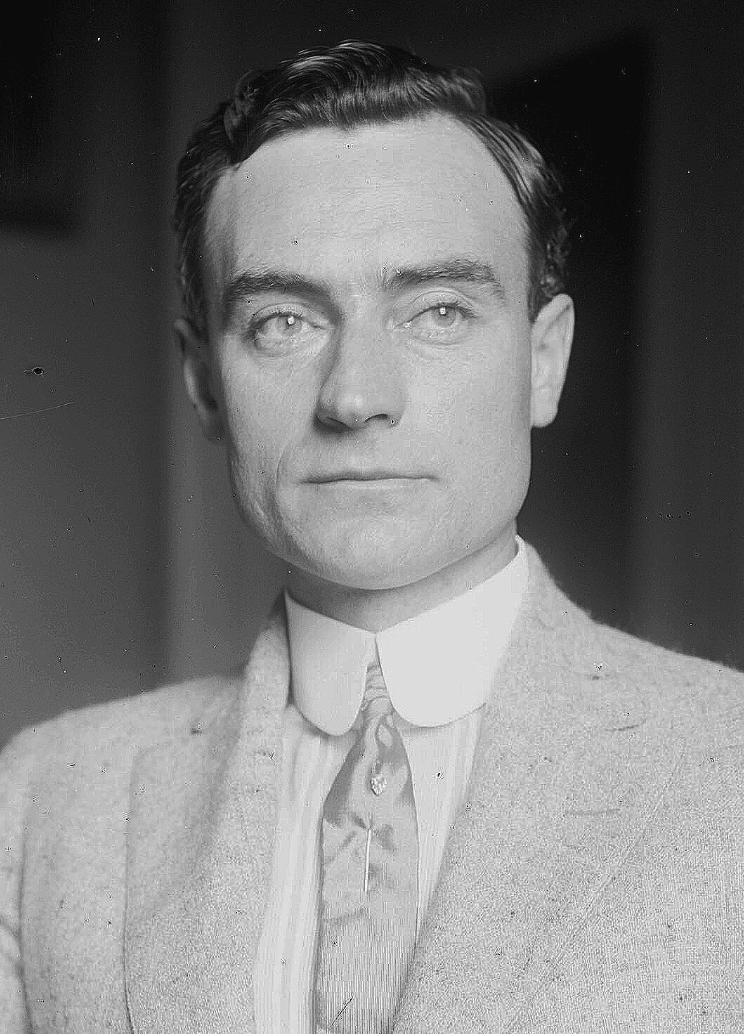
Not only New Yorkers, but people around the world are buzzing about New York’s mayoral elect, 34-year-old Zohran Mamdani, who will become the second youngest man ever to be elected as the city’s mayor. A would-be reformer, Mamdani promises results and change. Mamdani is, to say the least, a highly polarizing figure, which reminds me of another highly polarizing thirty-four-year-old who was elected mayor of New York, “The Boy Mayor,” Irish American John Purroy Mitchel. Elected with the greatest margin of victory ever in 1913, Mitchel and Mamdani share a number of similarities in terms of youth, ambitious agenda and desire to reform the city.
More than a century after his death, evaluations of Mitchel differ widely. Journalist Oswald Villard, the editor of The Nation called, him "the ablest and best Mayor New York ever had." Former President Theodore Roosevelt endorsing Mitchel's re-election bid in 1917, claimed that he had "given us as nearly an ideal administration of the New York City government as I have seen in my lifetime.” However, A 1993 survey of historians, political scientists and urban experts, conducted by Melvin G. Holli of the University of Illinois, ranked Mitchel as the 17th-worst American big-city mayor to have served since 1820. Many Irish American New Yorkers despised him.

Mitchel was born in the Fordham section of the Bronx on July 19, 1879. His mother was of Venezuelan ancestry, and so Mitchel became the first man of Hispanic heritage ever elected mayor. Mitchel was raised as a Catholic, though his famous grandfather, Irish revolutionary John Mitchel was a Presbyterian. Still a hero in Ireland, the elder Mitchel was one of the leading figures in the Young Ireland movement before he was convicted of sedition and deported to Australia, where he was spectacularly rescued from a penal colony by Fenians and brought to New York where he received a hero’s welcome. He would throw in his lot with the South generally and the Confederacy during the Civil War, with his three sons fighting for the cause, two of them dying. The survivor was James Mitchel, son of the future mayor.
The younger Mitchel went to what would later become Fordham Prep where he showed himself to be shy and ill-at-ease with social interaction, but a leading intellect. He graduated in 1899 from Columbia College, where he debated, and then graduated with honors, from New York Law School in 1901.
Mitchel burned with a passion for reform and rooting out corruption. As a relatively unknown young lawyer, he became Commissioner of Accounts in 1907, where he discovered and publicized many examples of corruption by the Manhattan Borough President Ahearn, which led to the Governor of New York removing the Borough President. Mitchel’s investigation of the Bronx Borough President also led to his removal. Gaining a reputation as a fighter against corruption, The New York City Republican Party nominated him to be President of the Board of Alderman where he produced the city’s first comprehensive budget, which helped to expose and eliminate fraud, waste and abuse.
By 1913, many New Yorkers had grown fed up with the corruption of the city’s infamous Tammany Hall political machine. The reform minded Citizens Municipal Committee set out to find a candidate that would give New York "a non-partisan, efficient and progressive government," and endorsed him as its choice for mayor. Nominated by the Republican Party as its mayoral candidate, Mitchel seemed attractive to Irish Americans because of his famous grandfather. Young and energetic, Mitchel won the 1913 mayoral election in a landslide with the largest majority of the vote in the history of New York Mayoral elections.
The city looked forward to an era of reforms and honest government in the administration of the “Boy Mayor,” but politics is about compromises and the incorruptible and rigid new mayor refused to make deals, alienating many of his potential supporters. His political style also came across as arrogant, moralistic and out of touch with the common man. His Ivy League pedigree, expensive suits and many friends in New York’s wealthy Silk-Stocking District created the impression that Mitchel was an arrogant upper-class elitist. Though Mitchel was a devout Catholic, he alienated this huge voting block by his investigation into corruption in Catholic charities.
In 1914, the unpopular mayor was nearly assassinated. Irish immigrant Michael Mahoney fired a gun at Mitchel as the mayor was getting in his car. The bullet missed and hit New York City’s corporation Counsel in the chin.
Mitchel served as mayor when the First World War broke out, a period when New York seethed with ethnic tension. “It was a really tough time to be mayor,” said Kevin C. Fitzpatrick, a historian and the author of “World War I New York: A Guide to the City’s Enduring Ties to The Great War.” Mitchel banned foreign flags including the tricolor and some ethnic parades, angering both German and Irish Americans. His belief that America should be ready to enter World War I on the British side alienated him from Irish New Yorkers. His conviction that New Yorkers should begin to train for combat alienated him from the huge number of New Yorkers who believed in American pacifism and isolationism. During his term, the city also suffered through the first pandemic, the Spanish Flu, which killed tens of thousands of New Yorkers.
Not surprisingly Mitchel quickly became very unpopular. He proved, however, to be an uncompromising reformer at a time when reform was not popular. He rooted out corruption and reformed the New York Police Department. The New York Times recently writing about Mitchel noted, “A lifelong foe of Tammany Hall, Mr. Mitchel pushed for maternity leave for schoolteachers, subway construction jobs for the unemployed and he appointed an African American member to the Board of Education — all moves that inspired a generation of future progressives, like Mayor Fiorello H. La Guardia.”
Fitzpatrick summarized his achievements saying, “His four years did a lot to change the laws that we enjoy today — labor laws, safety laws — and he was big into helping immigrants and the working class and their safety.” The first city zoning laws are perhaps Mitchel’s most enduring legacy. .
Swept into office in a landslide, Mitchel was swept out of office in 1917 by a wave of angry voters. He even lost the Republican nomination and running as a Fusion Party candidate received less than a quarter of the vote, barely outpolling the Socialist Party candidate.
Within two weeks of leaving office, Mitchel enlisted to serve in the Army Air Service as an air cadet. On July 6, 1918, he fell out of the aircraft he was flying in during training in Louisiana and died, because he had failed to fasten his seat belt. Though an unpopular mayor, his wartime funeral drew thousands of New Yorkers who watched his horse-drawn coffin parade up Fifth Avenue to St. Patrick’s Cathedral for his funeral. President Theodore Roosevelt, one of his friends, served as one of his pall bearers.
Mitchel Air Force Base on Long Island was named in his honor. F. Scott Fitgerald recalled Mitchel’s death in his 1922 novel “The Beautiful and Damned” in which the plane of Gloria’s former Ivy League flame falls “1,500 feet at Mineola a piece of a gasoline engine smashed through his heart.” A plaque of his likeness is located on an entrance to the base of the Jaqueline Kennedy Reservoir in Central Park honors Mitchel. Another plaque at Columbia University honors the “Boy Mayor.”
Let’s hope that our next “Boy Mayor” has more success and popularity than Mitchel did.