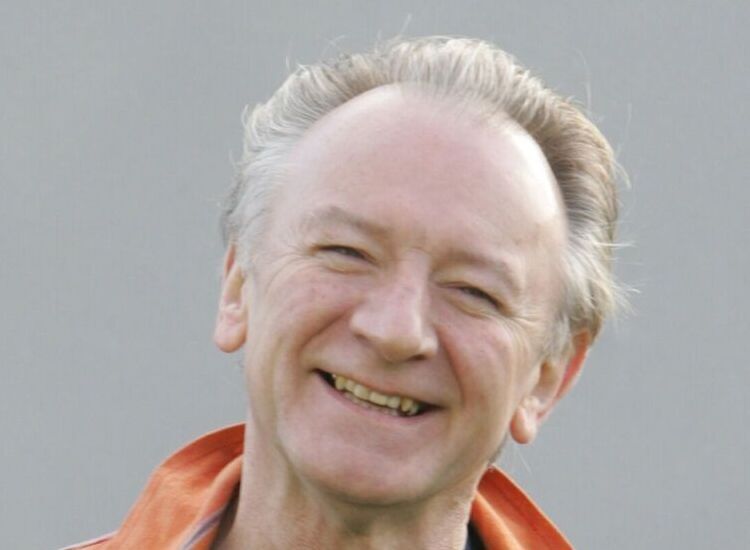
Twinkly-eyed and chubby cheeked, Malachy McCourt was a much larger build than his brother Frank, but arguably remained in Frank’s shadow. Malachy’s older brother won global recognition for “Angela‘s Ashes,” his Pulitzer-winning 1996 memoir, which sold more than 10 million copies and was made into a movie.
In New York, however, Malachy, was something of a legend. Prominent and beloved in Irish-American circles, Malachy has posthumously received his third official recognition from the city.
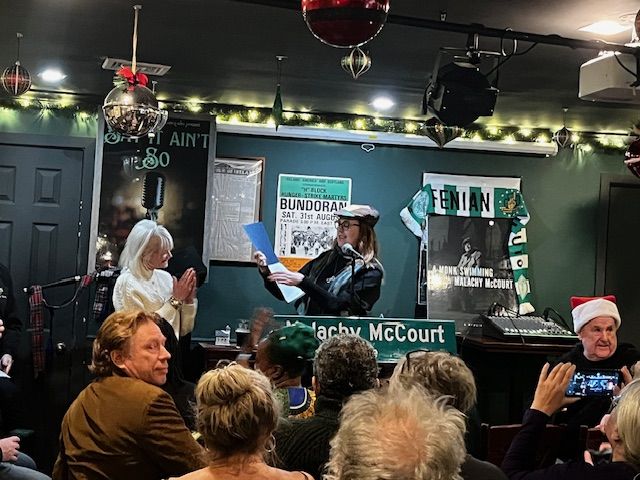
The backroom of a Manhattan bar was filled last Thursday with people who braved bitter temperatures to see the former speakeasy designated the Malachy McCourt Room At Ernie O’Malley’s,. The Certificate of Recognition, signed by Mayor Adams, was presented to McCourt’s daughter, Siobhan McCourt, by Chantal McLaughlin-Khan on behalf of the city. McLaughlin-Khan is a Senior Editor and Special Projects Manager in the New York City’s Mayor's Office of Correspondence.
John McDonagh, a friend of Malachy’s and fellow WBAI Radio person who helped organize the latest tribute to him, said, “The city gets thousands of requests a year,” for such gestures of recognition.
Previously, Malachy got an official proclamation from New York’s last mayor, Bill de Blasio, who declared March 17, 2021, "Malachy McCourt Day."

And in 2025, following Malachy’s death in March 2024, New York City Council renamed a stretch of West. 93rd Street by West End Avenue in Manhattan to Malachy McCourt Lane. This, in a nod to the lane in Limerick city, where the McCourt brothers were raised in dire poverty in the 1930’s.
The recently presented certificate described Malachy as an, “acclaimed actor, author, radio, personality and progressive activist who enriched New York’s cultural landscape for decades.… [A] brilliant raconteur who enjoyed singing rousing songs from the Emerald Isle.”
“This room in his honor will uphold his rich legacy and passion for community events where people inspire others through comedy, literature, music, storytelling, and more.”
Malachy would surely have approved of the mix of personal anecdotes, political songs, poetry and even a rap comprised of his words. He was the author of five books, including the best-selling memoir, “A Monk Swimming,” a stage and screen actor, radio host, publican, would-be politician, and funny co-founder of the Irish, American Artists & Writers Association.
He surely would have approved of being commemorated in a speakeasy and appreciated the frequent irreverence of the occasion. Siobhan told a story of shouting after the priest who left a confession box without giving her absolution because she wasn’t regularly attending Mass.
Gay activist Brendan Fay read from a story, “How I found Jesus on Christmas.” The Jesus in question was a handsome Puerto Rican who helped Fay come out after he’d emigrated to New York. When Fay’s mother asks on a phone call, “Have you found a woman in America?” he replies, “The only women in my life are you and the Virgin Mary.”
Fay, who founded Saint Pats for All, an alternative to the St. Patrick’s Day parade on 5th Ave., told the Echo” at the event that Malachy wheeled alongside the marchers in Sunnyside, Queens, “a few weeks before he died.”
Malachy was happy to court controversy, and, having known hardship, leaned left in his politics.
McDonagh told a story illustrating this. (The former New York City cabdriver runs a bi-monthly storytelling series in Ernie O’Malley’s.) When baseball team The Brooklyn Cyclones decided to honor Malachy at one of their games they warned McDonagh, “We know Malachy ran for governor [of New York, in 2006] but we don’t do politics here.”
Duly cautioned, Malachy took to the mic, opening with, “as Donald Trump said to his four wives, I won’t keep you long…” That was the first time that evening McCourt’s mic was cut off.
McDonagh left McCourt there with what he called the “MAGA crowd. I said, you were born in Brooklyn, and you’ll die in Brooklyn.”
Malachy, who was raised in Ireland, never lost his Limerick accent—or the local habit of calling people, “Love,” long before Millennials recently adopted the term.
Myss Uneek, a slam poet, who also paid tribute to Malachy on Dec. 11, remarked, “Any time we’re in a room celebrating his life, it’s always packed.”
Perhaps Malachy was onto something when he named his last book, “Death Need Not be Fatal.”