Splendid isolation was the view over many decades.
Europe might be engulfed in war but Ireland, off the continent's edge, was sitting both pretty and safely.
Indeed, during the Cold War, Ireland was identified by quite a few people in Europe, Germans in particular, as the safest place to be if the bombs, atomic ones, started to fall.
Kerry became an especially popular bolthole, literally.
The reason for this was the fact that nuclear armageddon in Europe and next door Britain, with the resulting fallout, would be kept at bay by both distance and the prevailing westerly winds.
Meanwhile, the United States, which presumably would also be taking nuke hits, was three thousands miles away.
Ireland, indeed, was splendidly isolated.
Not any more.
The front line has arrived at Ireland's door.
Between Russian bombers flying down the west coast with transponders switched off, Russian navy ships converging on waters in Ireland's Exclusive Economic Zone (and having to be chased away by fishing boats) and the recent drone incident in the sea off Dublin as the plane carrying Ukrainian President Volodymyr Zelenskyy made it final approach to Dublin Airport, the penny is finally dropping with a thud.
In this new era of Russian aggression and expansionism the theater of potential conflict has reached all the way to Ireland's scenic shores.

And the island of Ireland, as was the case over centuries, is being viewed again as a vulnerable back door to Europe. And a back door lacking a sufficient military locking key. The Irish government seemingly recognizes this and there has been much talk about ramping up the Republic's military capabilities.
The Zelenskyy incident was especially embarrassing because the Irish navy ship stationed close to the flight path, the LE William Butler Yeats, did not possess the technology to jam the five drones which may well have been controlled by an unidentified "dark" ship which was positioned in the Irish Sea but not far outside Irish territorial waters.
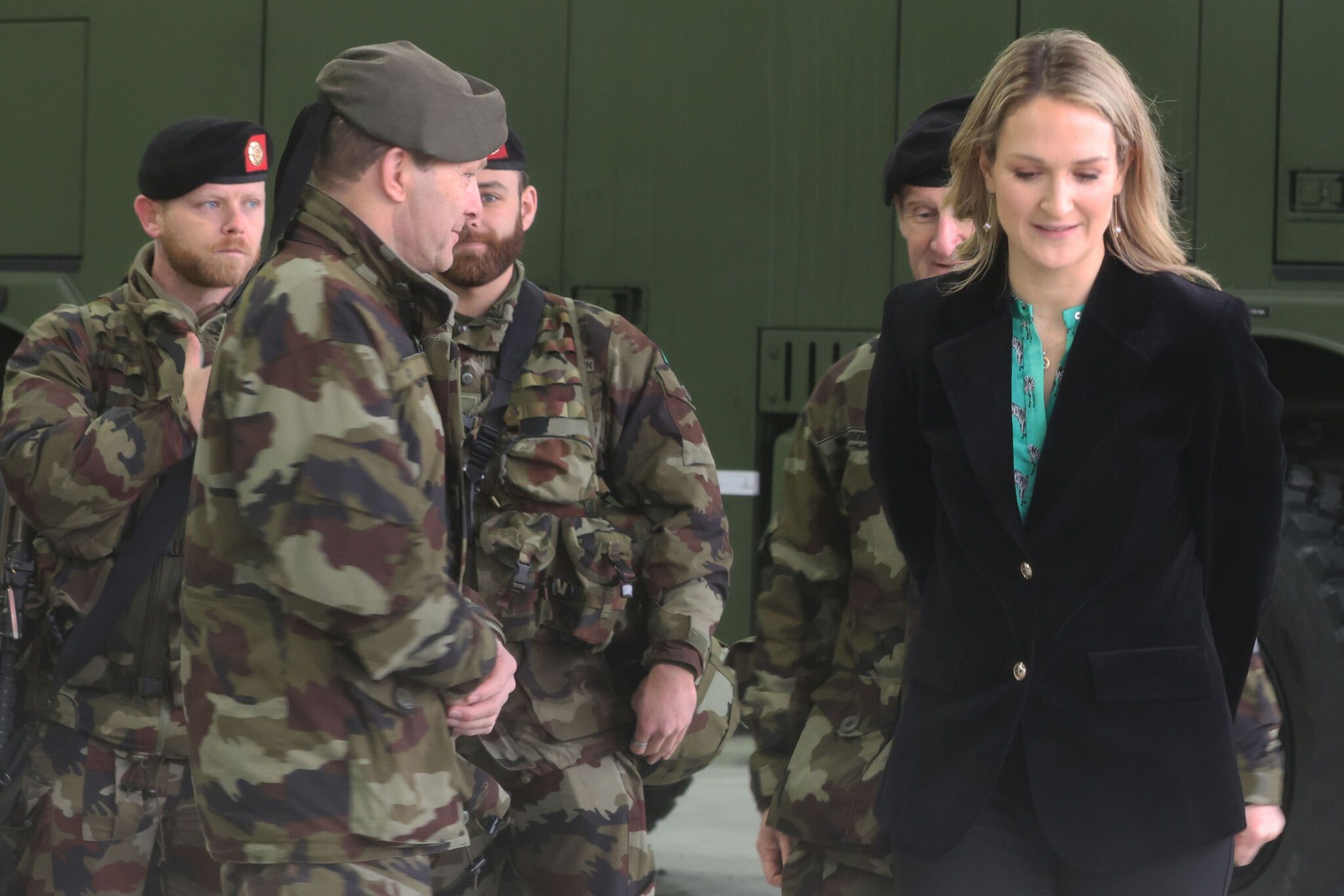
The inability to jam drones will be addressed in a just announced €1.7 billion Irish Defence Forces plan and an ability to "identify and neutralise" drones will be available to the Irish military by the summer of 2026, this according to the Irish government's Minister for Foreign Affairs, Trade and Defence, Helen McEntee.
A new long range radar system designed to identify an array of aircraft and drones will be in place by 2028.
Not a moment too soon.
What is hurriyng things along is the fact that Ireland Ireland will host the presidency of the Council of the European Union from July 1next year.
The presidency will feature a meeting of EU ministers in Dublin. Said minister will be flying in.
Asked a few days ago whether an underinvestment in defence raised questions about Ireland’s capabilities to host the EU presidency next year, Minister McEntee responded “absolutely not."
She also said it was “essential” that Ireland’s defence continued to be funded amid “changing” and “emerging” threats.
McEntee added: “My focus and priority as Minister for Defence, working with the department and working with the Defence Forces, is to make sure that the Defence Forces are growing, expanding, and that we are enhancing capabilities at every step of the way. “In many instances – and I’ve seen this from my colleagues across the EU – these drones are there to disrupt, and we’ve seen very recently, hundreds of millions euros worth of disruption was caused because of drones in airspace. That didn’t happen last week.”
“We’re not immune to the changes and the challenges that we’re seeing across the world. We’re not immune to the new types of hybrid threats that we’re seeing happening on a regular basis. We’re not immune to the cyber threats that are happening as well, that are impacting our businesses, our governments, our state agencies."
McEntee is correct. In a time of ever expanding technological warfare there is no such thing as geographical isolation.
If the five drones were indeed controlled by Russian hands those hands could have been anywhere - on the "dark" ship, in Moscow, in Murmansk, on ground seized from Ukraine. Anywhere.
Ireland might not be in the geographic heart of Europe. But it is a functioning, and increasingly strategically important, limb.