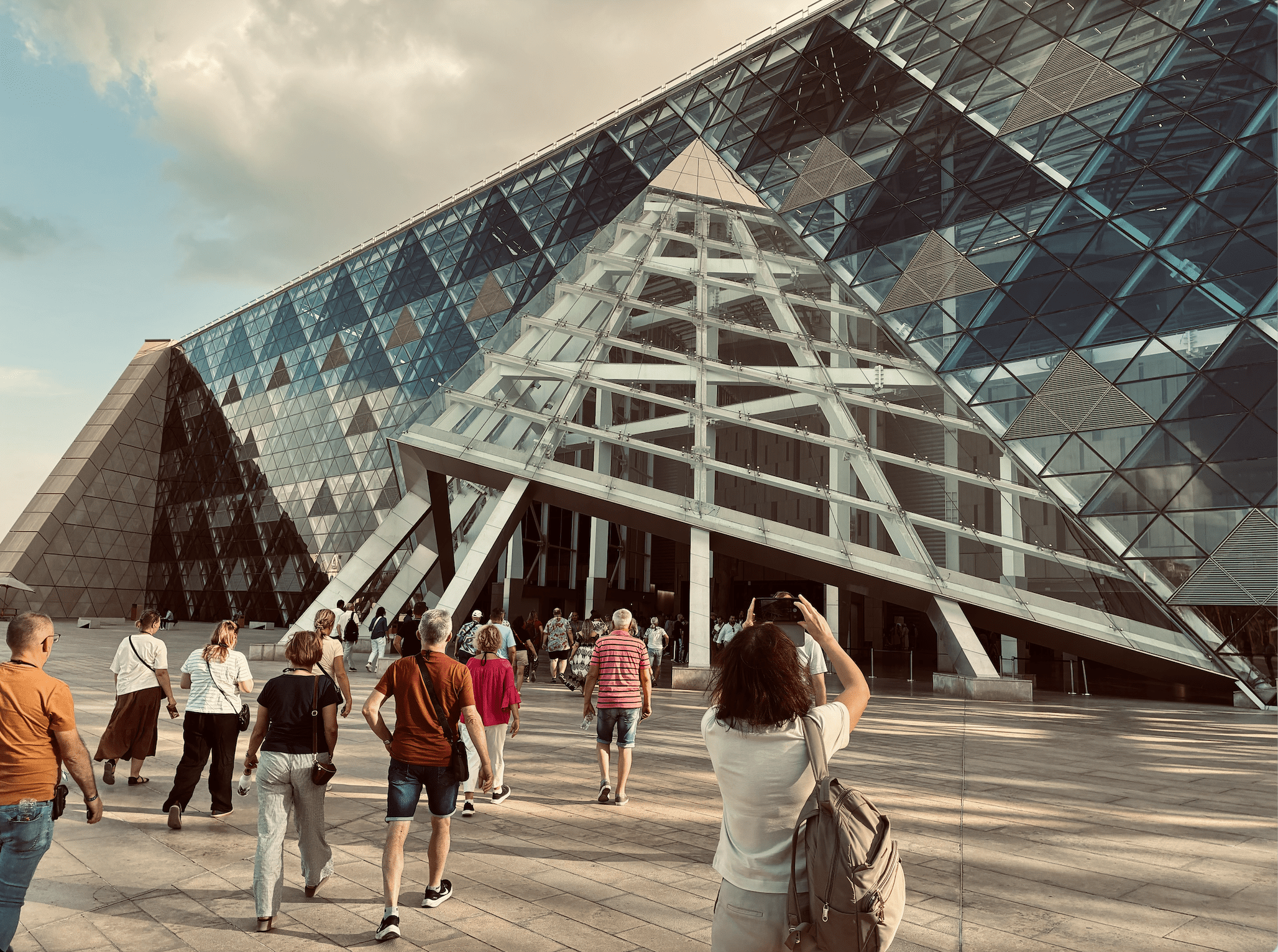
I just visited the stunning new Grand Egyptian Museum in Cairo, Egypt. As a writer I am not supposed to be at a loss for words, but this amazing building, the largest archeological museum on Planet Earth packed with some 100,000 artifacts covering some seven millennia of the country's history from pre-dynastic times to the Greek and Roman eras simply left me speechless. I was even more gobsmacked when I learned that this magnificently designed edifice is the creation of an Irish woman, Róisín Heneghan from County Mayo and her husband Chinese American Shi Fu Peng. It’s hard to grasp the vastness of the museum, whose 5.4 million-square-foot size, sprawling over an area larger than 90 football fields, is really several museums in one. It is so large that it is nearly impossible to see everything there in one day, but I made a concerted effort to see as much of it as I could, and I marveled at the ingenuity of the design in every corner of the museum. It took nearly two decades to complete this vast edifice. The project was delayed by financial crises, the 2011 Arab Spring – which deposed Egypt’s president and led to years of turmoil — the Covid-19 pandemic and regional wars. In 2005, 1,500 firms submitted their plans for the prestigious museum including some of the most renowned architectural firms in the world, but the architectural world was taken aback when the small Irish firm of Heneghan Peng won the competition. The long-awaited opening of the museum finally took place Nov. 1st. Egypt took great pride in the opening of this amazing museum. The nation invited presidents, kings and crown princes from Europe and the Arab world. They rolled out red carpets; staged drone shows and made speeches about civilization’s cradle reawakening. The message was not subtle: Egypt is back on the global stage.

At the opening ceremony President Abdel Fattah El-Sisi noted that the Grand Egyptian Museum is a "living testament to the genius of the Egyptian people" and a "gift from Egypt to the world." He also stated that the museum is a beacon for the future, inspiring future generations and reminding people of the importance of the mind and memory. "We hope the Grand Egyptian Museum will usher in a new golden age of Egyptology and cultural tourism," says Ahmed Seddik, a guide and aspiring Egyptologist by the pyramids on the Giza Plateau. "It was my dream. I'm really happy to see this museum is finally opened!" Dr Zahi Hawass, Egypt's former long-time minister of tourism and antiquities, told the BBC. The world-famous archaeologist said it shows that Egyptians are equals of foreign Egyptologists when it comes to excavations, preservation of monuments and curating museums. The brilliant design creates a huge modern space that connects with the ancient Giza Plateau, emphasizing the relationship between the museum and the massive pyramids visible from its galleries. Heneghan’s design has been praised profusely for its sophisticated connection to the ancient pyramids. The triangular façade and overall geometry intentionally engage the visitor with the ancient pyramids, creating a "silent architectural dialogue" with the ancient landscape. The design has received kudos for successfully blending modern architecture with Egypt's ancient heritage, seamlessly incorporating massive scale and contemporary technology with classical artifacts.
Critics have described the interior as theatrical, with a six-story-high grand staircase featuring hulking statues that ascends to the top of the museum, fueling an overpowering sense of awe and anticipation. Perhaps the most stunning architectural feature of the museum is the set of large windows that frame unobstructed views of the majestic Giza pyramids from the top of the grand staircase.
“What we did was we put the permanent exhibition galleries up at the top, because it's from there you can see to the pyramids,” Heneghan said. “It's very much about that relationship to the pyramids and trying to point to the biggest artifact, the pyramids, which are outside of the museum,”
She also stated, “We looked to create a new face to that desert plateau, staying below the level of the Nile and creating a new line that unfolds to take in the view of the three pyramids.” Heneghan stated, “The site is very, very close to the pyramids, and for us that was what was most important.”
Though the museum is meant to attract some five million foreign tourists annually, it was also designed with ordinary Egyptians in mind. “We were trying to think about it outside of just tourism, thinking about how it might support the Egyptian community as well,” she said.
There are a lot of learning and educational spaces too. “Cairo has very little open space,” she says. “So, what we also wanted to do was develop the gardens to the front of the museum, so that it might also become a resource for this west side of Cairo.”
There is another aspect to the vast size of the museum. It is large enough to be able to display many of the amazing ancient Egyptian artifacts that now grace museums around the world. Though the museum displays an amazing 50,000 artifacts, there are six times as many antiquities in museums around the world as in the new museum. Egypt wants its treasures returned and now there is no longer the excuse that Egypt lacks the facilities to display them.
Dr. Hawass said, “Now I want two things: number one, museums to stop buying stolen artifacts and number two, I need three objects to come back: the Rosetta Stone from the British Museum, the Zodiac from the Louvre and the Bust of Nefertiti from Berlin.”
Dr Hawass has set up online petitions – attracting hundreds of thousands of signatures – calling for all three items to be repatriated. The Rosetta Stone, which now lies in London’s British Museum, provided the key to deciphering hieroglyphics. It was discovered by the French army and was seized by the British as war booty. A French team also cut the Dendera Zodiac, an ancient Egyptian celestial map, from the Temple of Hathor in Upper Egypt in 1821. Egypt accuses German archaeologists of smuggling the superbly painted colorful bust of Nefertiti, wife of Egyptian pharaoh Akhenaten, out of the country more than a century ago. "We need the three objects to come as a good feeling from these three countries, as a gift, as Egypt gave the world many gifts," Dr Hawass said.
Heneghan’s biography is as amazing as her designs. She was born in 1963 in remote Belmullet, and received a Bachelor of Architecture degree in 1987 from University College Dublin before being accepted to Harvard’s prestigious school of architecture where she earned a Master of Architecture Diploma. She and her husband founded Heneghan Peng in New York in in 1999 and in 2001 moved it to Dublin. That same year the firm won the coveted American Institute of Architects Award. The firm has also won international acclaim for its design of the Giant’s Causeway Visitor’s Center in Northern Ireland. Heneghan Peng’s other achievements include the refurbishment of the National Gallery of Ireland Historic Wings, the Old Library redevelopment at Trinity College Dublin, Storm King Art Centre and a visitors’ center at the Botanic Gardens Berlin.
In 2024, Heneghan was inducted into the prestigious Aosdana, an Irish association or academy of artists, each of whom must have produced a distinguished body of work of genuine originality. All these accolades pale in comparison to her success in creating one of the most beautiful museums in the world. With the completion of the museum, her firm has overnight become one of the most prestigious architectural practices on the planet.