
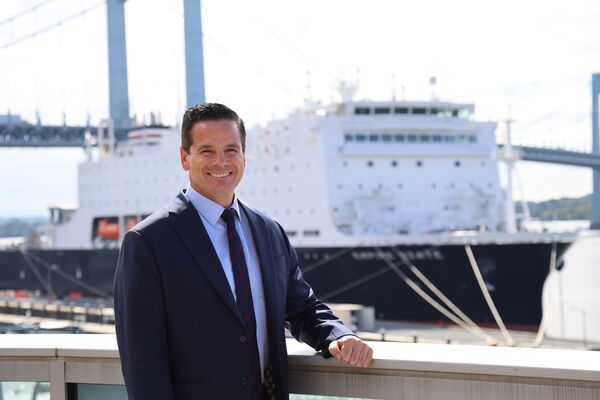
Captain Thomas Murphy, USN (Ret.) is Chief of Staff and Executive Director for Legislative and Government Affairs at SUNY Maritime College.
Bibliography
A member of the Class of 1993, Captain Thomas Murphy brings more than 30 years of distinguished service as a U.S. Navy special operations officer, most recently as Chief of Current Operations at U.S. Indo Pacific Command. A qualified Surface Warfare Officer, Diving and Salvage Officer, Master EOD Technician, and Naval Parachutist, Captain Murphy has received numerous military honors. He holds degrees from SUNY Maritime College, Benedictine College, and the National Defense University.
How do you celebrate your Irishness?
I celebrate my Irish heritage through community, service, and tradition. One meaningful way is marching each year in the Bronx Throgs Neck and New York City St. Patrick’s Day Parades—events that reflect the pride, resilience, and camaraderie central to Irish culture. Beyond the parades, I value the Irish commitment to storytelling, loyalty, and respect for history, principles that have shaped both my personal life and professional career. These traditions reinforce the importance of service to others, strong family ties, and giving back to the communities that helped shape who I am today.
Name a maritime hero you admire
A maritime hero I deeply admire is Rear Admiral Draper Laurence Kauffman, the first U.S. Navy officer from the Explosive Ordnance Disposal (EOD) community to achieve flag rank. Rear Admiral Kauffman was a true pioneer whose courage and ingenuity laid the foundation for modern Navy EOD operations. Having refined his bomb disposal expertise with the British Royal Navy Volunteer Reserve during the London Blitz, he brought invaluable experience to the U.S. Navy at a critical moment in history. Just days after Pearl Harbor, he was dispatched to Hawaii, where he safely disarmed and recovered a live 500 pound Japanese bomb outside a weapons magazine at Fort Schofield—a mission requiring extraordinary composure, technical mastery, and personal bravery. His leadership during World War II, for which he earned the Navy Cross twice, exemplifies the professionalism, sacrifice, and quiet heroism that define the maritime and EOD communities.
What did you learn in your first job which has been useful to you throughout the career?
In my first job, I learned the importance of personal accountability and teamwork—lessons that have stayed with me throughout my career. I quickly understood that success in any maritime mission depends on trust: trust in your shipmates, in your training, and in your ability to make sound decisions under pressure. I also learned that attention to detail and preparation are non negotiable, as even small oversights at sea can have significant consequences. These early lessons instilled a leadership philosophy centered on responsibility, discipline, and putting the mission and the team above oneself.
