In the fall of 1937, 14 American seamen were arrested by federal agents on the S.S. “Algic” in Baltimore and charged with “revolt and mutiny.” Nine of them were eventually sentenced to two-month prison terms and the five others received $50 fines. This was the outcome of an action they’d taken in the faraway port of Montevideo, the capital of Uruguay. The men had for a time refused to unload their cargo from the U.S. government-owned, privately-leased “Algic” in support of local striking longshoremen.
The Maritime Commission was taking a hard line, and several officials, from President Franklin Roosevelt on down, had expressed concerns about conditions on American ships and the reported lack of crew discipline. That act of international solidarity in South America was apparently the place where the line would be drawn.
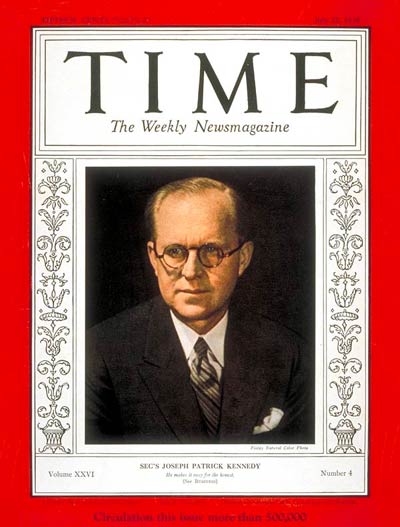
A few weeks after his second inauguration on Jan. 20, 1937 (the first use of that permanent date), FDR tapped self-made tycoon Joseph P. Kennedy to be his head of the Maritime Commission, which had been established a few months previously. The Bostonian had already served as the president’s first commissioner of the Securities and Exchange Commission. Despite concerns that someone who’d become rich on Wall Street before it crashed in 1929 (he had in fact actually made his real fortune a little later with the astute buying and selling of companies in Hollywood) was the wrong person for such a position. But Kennedy proved to be a success in putting in place new rules to rein in rampant speculative capitalism.

There was a hurdle first to be cleared: the Merchant Marine Act of 1936 stipulated that the commissioner should not have stock, or have had any over the previous three years, in a shipping company. Kennedy, however, had a long-time connection to Todd Shipbuilding; and while the solicitor general ruled that it shouldn’t be a problem, several congressmen thought otherwise.
So, to facilitate the presidential nomination, special legislation was passed on March 30 that said Kennedy “shall be deemed not to be in violation” of the act. Two weeks later, he started as commissioner.
The financier had hoped for a more senior role in FDR’s second term, perhaps a Cabinet post. He really coveted Treasury, but that was held by Henry Morgenthau Jr., who wasn’t going anywhere. Kennedy decided in the short term to take whatever was offered to prove his continued loyalty to FDR.
Early in his tenure, he made what biographer David Nasaw referred to in “The Patriarch” as a “brave speech and a foolish one.” It was the keynote Saturday night address to wrap up the 25th weekend reunion of his Harvard class.
Nasaw writes, “Instead of rehearsing (as was customary) the ways in which his success in life could be attributed to his four years on campus and telling silly stories and flattened out jokes about his classmates, he delivered an uncalled-for, unexpected, and unpardonably political speech.
“Before an audience that was largely anti-Roosevelt and anti-New Deal, he defended not only big government, but Social Security and organized labor. And then, to add provocation to provocation, he praised John L. Lewis, the principal organizer of the Congress of Industrial Organizations (CIO) and perhaps the single most hated man in banks, boardrooms, and Harvard clubs.”
Kennedy’s actual position as boss of the Maritime Commission was to put him at odds with labor, particularly the CIO. In one of its long headlines in all caps on a front page story on May 22, the New York Times summarized his policy outlined at the Propeller Club in the Hotel Astor in Manhattan the previous day: “Merchant Marine to Equal any Rival. Maritime Board Head Plans to Build New and Faster Ships in Immediate Future, Aid of Capital Asked. Government is Ready to Take Initiative… ‘Square Deal’ for Labor, Men Afloat to be Treated as Those Ashore, But Loyalty will be Demanded of Them.”
Kennedy accepted that conditions had not traditionally been good for workers on ships, and in his earlier Harvard address had criticized government and business’ undermining of organized labor. His solution of “compulsory arbitration,” though, was not music to the ears of unions, least of all those attached to the CIO.
There were two Roosevelt Administration concerns. First was the ongoing labor strife, complicated by CIO and American Federation of Labor rivalry; there had been two long strikes in recent years on the West Coast, one of which became a general strike in San Francisco.
The second was the worsening geopolitical situation — the civil war in Spain raised the specter of a world war, and conflict was breaking out in Asia. Even an isolationist Congress knew the implications of war for American trade.
In any case, Kennedy intuited that FDR wanted a strong hand in charge.
The “Algic” episode pitted him against the most progressive sections of the New Deal coalition. National Maritime Union President Joseph Curran promised he was “going to get Kennedy’s scalp” as a result of the Baltimore arrests. Labor Secretary Frances Perkins extracted an apology from Curran for personalizing the dispute, which Kennedy accepted. He wasn’t budging, though. When the president called his commissioner to urge caution, he could see he wasn’t backing down, and FDR knew that the side taking on labor would always have majority support and thus the upper hand in a standoff.
Kennedy’s main problem in life was he couldn’t shut up, particularly in private conversation telling people what they wanted to hear, which could be distorted after the fact (a real problem in his next job). But he was a natural showman and had a genius for public relations. He had the help of key media people in both regards. Perhaps the most shocking revelation in Nasaw’s 2012 biography is that Arthur Krock, one of the top people in the New York Times, spent long stints on the Kennedy payroll.
He was asked by a Congressional committee in December about his eight-month tenure: “How many ships have been laid down in that time?”
“One” was his reply.
He made sure the world knew that the problem was with Congress itself, and not the administration, which wanted to advance Roosevelt’s plan to build ships, and lots of them.
Through all of this, friends, government officials and business associates knew that Kennedy’s family was a top priority. In the summer of 1937, two of his children, 13-year-old Pat and Bobby, 11, were hospitalized with an acute case of appendicitis and pneumonia respectively.
“I just got back to Washington this week,” he wrote to a friend on Sept. 9, “after having stayed up at the Cape with two very sick children…I gave up all business and confined myself exclusively to them.”
All nine children would become famous when Kennedy took up his next government appointment in early 1938 after less than a year as Maritime Commissioner, which was ambassador to the Court of St. James in London.
Many within the administration were deeply suspicious of Kennedy; but he had his allies in his quest for promotion, most notably his close protégé James Roosevelt, the president’s son.
The idea of the London position really grew on him after it was first floated. He would be the first Irish Catholic in a post that had been held by future presidents, John Quincy Adams and James Madison among them, as well as numerous other notable, high-profile WASPs over the generations.
Earlier in 1937, he’d seen a draft of a Fortune magazine profile of him, and forced a change of writer and a total reworking of the piece. He had taken particular umbrage at the reference to his late father, P.J. Kennedy, as a saloon-keeper who had entered government service to increase his “opportunities for the acquisition of wealth.”
It was against that backdrop that friends begged the “most undiplomatic man in Washington” not to take the London job; the clincher for him, on the other hand, was that from the moment he was confirmed, he would forever be called “Ambassador Kennedy.” It was that title in his view, as much as his wealth, that would open doors for his children.
It turned out that his brief Maritime Commission stint would be the high-water mark in Kennedy’s public service career. His early national reputation was that of the red-headed, two-fisted, straight-talking Bostonian who could be counted on for his perseverance, capacity for work and ability to get the job done.
When he appeared before the Senate Commerce Committee in late February 1938, its chairman, Senator Royal Copeland, said, “The members of this committee are very sorry you are leaving your present post to go to England. We wish you would stay here.”
One of those friends Kennedy had consulted about the London position predicted that if it didn’t go well, any possibility of a political career would be closed off to him. And so it proved. And while Kennedy would serve on boards and advise in different capacities, he was never again offered a meaningful government role of any description.
In the longer term, in the view of Nasaw’s “The Patriarch,” Joseph P. Kennedy’s philosophy did find lasting expression in one of JFK’s best-known lines: “Ask not what your country can do for you, but what you can do for your country.”