In the “Acknowledgements” section of her latest book, Lucy McDiarmid reveals she loved showing her students “what a social occasion a poetry reading could be.”
It helped that she was the first Marie Frazee-Baldassarre Professor of English at Montclair State University in New Jersey.
“With its generous funds,” McDiarmid says about the endowed chair, “I was able to invite to my classroom Irish poets, American poets, and lecturers from all over. The preparations for those guests, the class discussions, and the opportunity to question the poets about their work inspired many of the ideas in the following pages.”
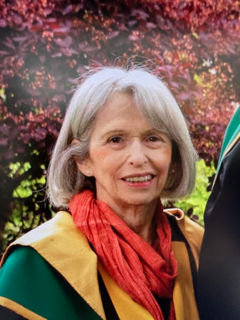
Author Lucy McDiarmid.
The book is entitled “Slightly Magical Irish Poetry and the Long 1990s,”and is being launched in New York in the coming days and in Ireland next week. It’s the latest addition to McDiarmid’s distinctive contribution to Irish studies, which also includes her most recent previous works, “At Home in the Revolution: what women said and did in 1916” and “Poets and the Peacock Dinner: the literary history of a meal.”
To mark its publication, the Irish Echo asked the author some questions about “Slightly Magical Irish Poetry and the Long 1990s.”

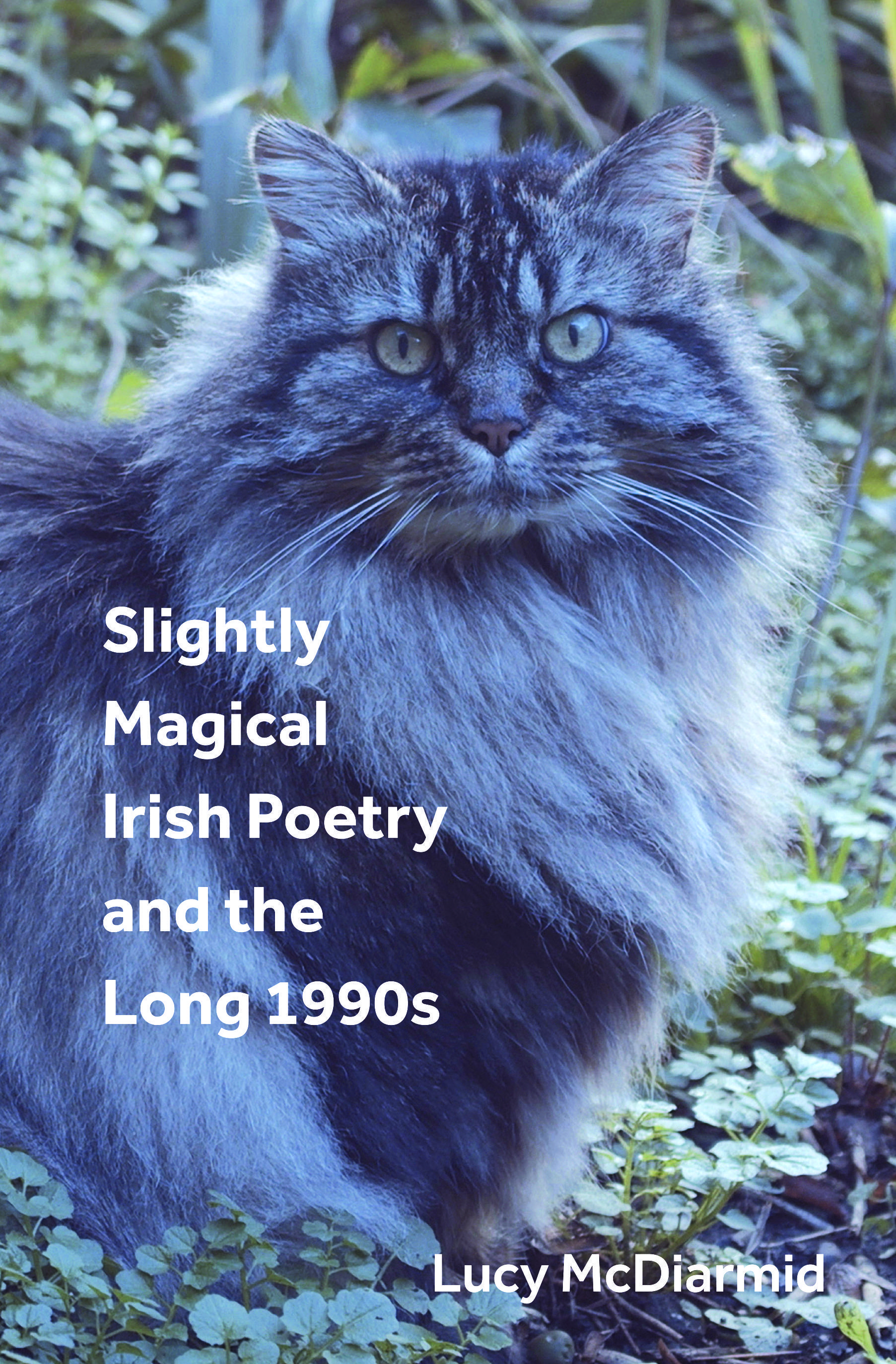
That’s a beautiful cat on the cover of your book.
Thank you! The cat’s name is Dora, and she belongs to one of the poets in the book. You’d be surprised how many Irish poets have cats.
So this is a book about Irish cats?
Cats, yes, but also liquids, railroad reveries, hair, the tongue, and encounters with ambiguous beings.
What do all of those things have in common?
I’ll tell you how I came to see them all in the same light. Back in 2016, I had just finished a book on women’s eye-witness accounts of the Easter Rising, “At Home in the Revolution,” and like everyone else who had written about the Rising, I was immersed in it. I wanted a change, so I decided just to read recent Irish poetry with no particular idea or topic in mind, just to see what emerged from the poems. Rereading poems like Eiléan Ní Chuilleanáin’s “Studying the Language,” Bernard O’Donoghue’s “Westering Home,” Theo Dorgan’s “The Lost Gaeltacht of Lower Manhattan,” Paul Muldoon’s “The Briefcase,” and Paula Meehan’s “The Statue of the Virgin at Granard Speaks,” I noticed that in all of them there was an element of magic, of something supernatural, something that was not consistent with the familiar laws of the ordinary world, but the magical element was not absolute: it was only “slightly magical.”
Can you give me some examples?
In “Studying the Language,” Ní Chuilleanáin begins, “On Sundays I watch the hermits coming out of their holes” as if this were a regular weekly habit, but the “hermits” she describes are like sixth century Irish religious recluses who lived in beehive huts. The speaker drinks from the same “pools of melted snow” as the hermits drink from; two worlds exist simultaneously.
And cats?
In “The Day My Cat Spoke to Me” by Martina Evans, the cat is quite chatty for a while but then stops talking and meows for her tuna. Is it a real cat or a magical talking cat? The poem doesn’t say.
And hair?
In Nuala Ní Dhomhnaill’s mermaid poems, hair exists on the head in the usual way, but it also seems to have autonomous powers. The speaker of Ailbhe Darcy’s poem “Hair” prays to a “Kind bolus of hair” as if it were animate.
What does all this have to do with the 1990s?
In all the poems I look at, the speaker never seems to need or even want an absolute explanation of whether the phenomenon is magical or ordinary. The poems are playful and resist definitive explanations. The metaphysical freedoms privileged in these poems relate, I think, to the feelings of liberation and release, often mixed with a note of resistance to and defiance of power, precipitated by the erosion of the absolute authority of the Catholic Church and the state in the southern part of Ireland. The freedoms of the slightly magical have a different relation to circumstances in some of the poems written by Northern Irish poets before the 1998 Good Friday Agreement. Those poems tend to set the slightly magical outside of Northern Ireland: Michael Longley’s “The Rabbit” is set in Poland, for instance, and his “Couchette’ on a European train.
How academic is this book?
It’s “slightly academic.” It does contain a lot of analysis, but what made the book fun for me to write was all my conversations with the poets. I integrate into the discussions things the poets said to me, so that there isn’t just one voice. You can hear their comments and my comments, even when we don’t agree. I wanted the vitality of the poets’ voices to be part of the book.
Lucy McDiarmid is a former fellow of the Guggenheim Foundation and of the Cullman Center for Scholars and Writers at the New York Public Library, and an honorary member of the Royal Irish Academy. “Slightly Magical Irish Poetry and the Long 1990s” was published by Edinburgh University Press on Halloween in 2025. The book is available in hardcover and as an ebook here. For sales during the month of January 2026, a 50% discount is available with the code MAGICAL 50.